
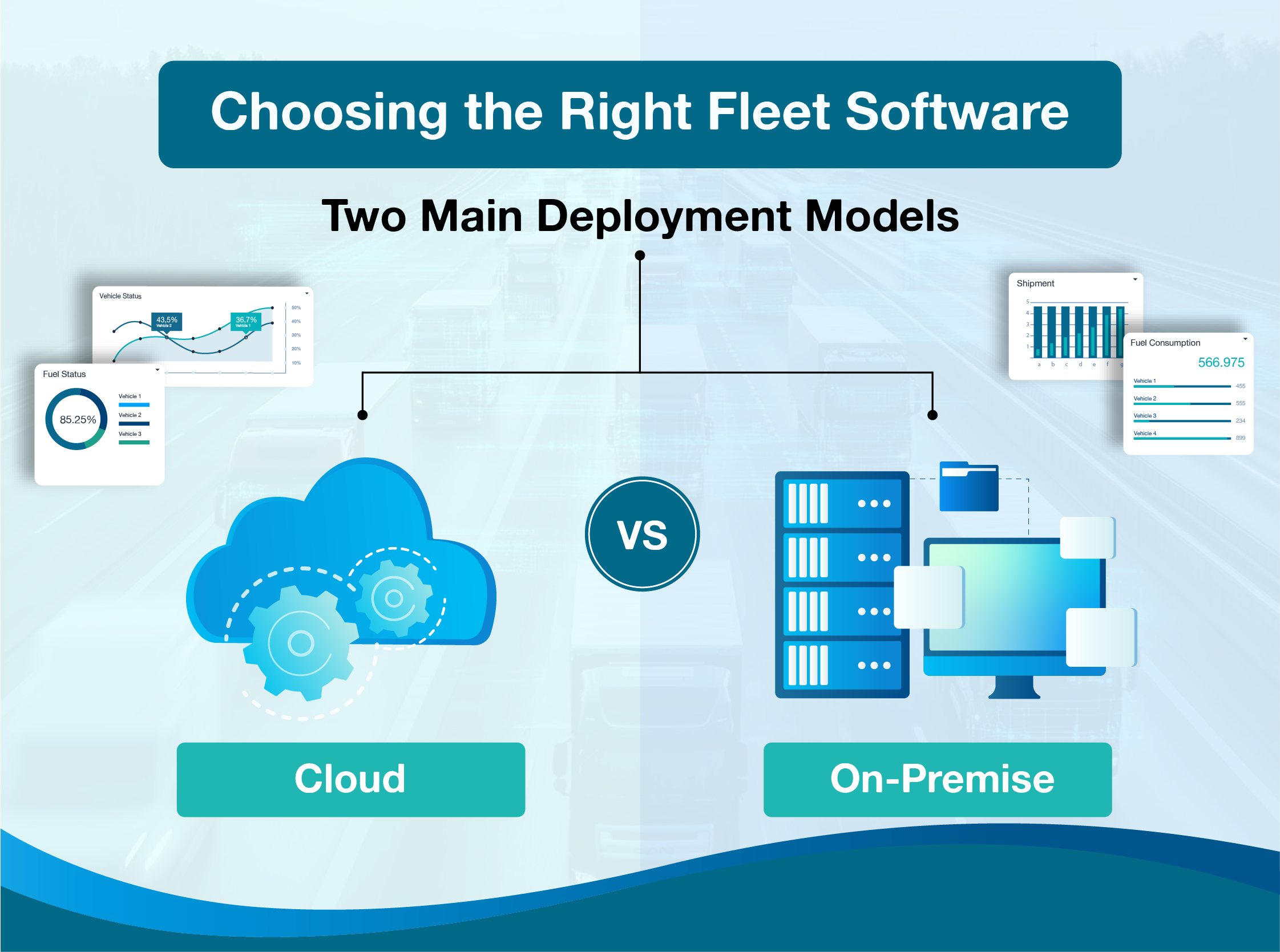
How do you manage your fleet? Traditional way or still using simple vehicle tracking for your operational needs? These ways are inefficient and provide limited scalability for your business. Modern logistics businesses need advanced cloud-based fleet management software. Your business needs to modernise its operations. However, many people often get confused between cloud and on-premise. Choosing the right fleet management solutions becomes important as the right software can connect every process of your fleet management operations, provide your business with scalability and improve visibility for your fleet. SpincLabs provides you with both cloud-based agility and on-premise control. Let us find the best software for your business needs and compare these cloudbased and onpremise software!
Cloud vs On-Premise: Choosing the Right Fleet Software
Compared to traditional methods, an intelligent fleet management system makes your operations highly visible. Traditional methods always remain inefficient; they are never cost-effective, scalable and provide limited visibility. On the other hand, fleet management solutions not only are capable of identifying the inefficiencies of your business operations but also make them efficient, scalable and cost-effective. However, choosing the right fleet management software is an important aspect. This is where people often get confused. Whether to choose a cloud or onpremise software for their business needs.
Don’t let these phrases cloud your thoughts to choosing the right fleet management software. The digital transformation is here, and logistics businesses are upgrading themselves with advanced fleet management solutions. But often people get confused between the two solutions, whether they should upgrade their logistics business with cloud-based fleet management solutions or choose on-premise solutions. Cloud-based fleet management means advanced, consistent, real-time monitoring and insights. The system remains awake round-the-clock, sending insights to your phone even if you are in a remote location. Since the intelligent fleet management system is always connected, you get real-time vehicle locations, reports on driver behaviour, and maintenance alerts to any device with an internet connection.
When comparing cloudbased and onpremise software, you should understand your business needs first. Let’s compare and understand cloudbased and onpremise software and find out the prime difference between public and private cloud.
Let’s Compare Cloud-Based and On-Premise Solutions!
When choosing cloud-based fleet management software and on-premise fleet management system, businesses often face a trade-off between agility and control. How? Comparing cloudbased and onpremise software is simple.
- The cloud solutions provide real-time data, faster updates, and remote accessibility. It becomes a lifeline for fleets spread across India’s states and time zones.
- On-premise solutions mean customization, full data sovereignty, and potential long-term cost stability.
Hence, your choice depends on whether speed and scalability outweigh strict internal governance requirements.
Cloud-based System
Any logistics business that includes distributed teams, has faster growth plans, and a hunger for data-driven agility, a right fleet management system is a necessity for it. For such a business, the cloud makes a lucrative and endless opportunity. Cloud-based means scalability with no expensive servers, no complex IT interference, just the smooth scalability you want for your business. Cloud platforms are growing at a higher frequency. They are accessible anywhere and need no infrastructure investment. Here, updates are automated, hence keeping compliance and security features updated.
- Real-time Data
Cloud-based system updates location, telematics data, and historical data of your fleet in real time and sends detailed reports on digital devices. - API
Cloud platforms can easily be integrated with your TMS platforms. ADAS system is often a matter of activating a pre-built connection or API. - Scalability
With a cloud system, you scale your operations at the speed of business, which means higher scalability than on-premise and traditional systems. - Smart Data Analytics
Smart data analytics means to collect all the data from and analyze it through AI to provide predictive maintenance alerts, fuel efficiency, detect anomalies and inefficiencies, and generate driver safety scores.
On-Premise Solutions
Now, if your logistics business or organization is handling sensitive government contracts, high-value locations, or fleets where privacy is your biggest concern, opt for on-premise. Why? These solutions are often preferred by legacy operators or businesses with the internal IT muscle to support upgrades and security internally. However, here, upfront investment will be a bit higher, but remember, it also means long-term savings for your business. Still comparing cloudbased and onpremise software for your business needs? You must go through the following comparison.
| Factor | Cloud | On-Premise |
|---|---|---|
| Cost | If you prefer ongoing operational expenses and want to avoid a large upfront cost | If you prefer a large, one-time capital expenditure and have a budget for it |
| IT Resources | Minimal IT overhead | Need a skilled IT department to manage servers |
| Scalability | Flexible and scalable | For a stable fixed fleet size |
| Accessibility | Data access through multiple locations or on the go. | Entire work management through a single, centralized location with an internal network |
| Security & Control | Advanced security through a specialized provider | Highly specific security through a closed private system |
The Difference between Public and Private Cloud
Understand both fleet management system or solutions in simple terms. Public vs private cloud means scalability versus control. Since public cloud solutions use shared infrastructure, businesses can scale resources and benefit from cost efficiencies and vendor-managed security. On the other hand, private cloud is a single-tenant solution with enhanced customization and stronger data isolation; hence, it is perfect for organizations with sensitive data, strict compliance mandates, or niche integration needs.
So if you want to prioritize speed, flexibility, and broad access, you should opt for public clouds. Or if you want ownership, custom policy enforcement, and sector-specific requirements, you must choose private clouds customized as per your business needs.
Traditional Methods vs Cloud-Based & On-Premise Software
Now, let’s come to traditional methods. If your business is still following the traditional methods for its logistics operations, you are bound to face inefficiencies and limited scalability. Also, traditional methods mean slower response, fragmented data, and high administrative costs. These aspects can be improved with automation and predictive features. Both cloud-based and on-premise software platforms provide your business with operational efficiency, accuracy, and make your business scalable.
Cloud-based tools negate the manual processes, such as paperwork, manual vehicle maintenance, and communication gaps and enable anywhere access through digitizing your processes.
Fleet Management Solutions From SpincLabs!
Remember, compared to traditional methods, an intelligent AI-enabled fleet management software is always an efficient way of doing logistics business. Rummaging everywhere to find a perfect cloud-based fleet management system? SpincLabs’ cloud-based fleet management solutions provide you with the scalability you want for your business. You can keep an eye on everything and generate a detailed report on every aspect of your fleet, such as vehicle health, driver behaviour, fuel consumption and management. Our advanced fleet management software includes real-time monitoring through video telematics, provides you with predictive analytics, and keeps an eye on driver behaviour. Also, since it identifies inefficiencies, you can work on improvements, negate fuel waste, and hold drivers to higher standards of safety.


