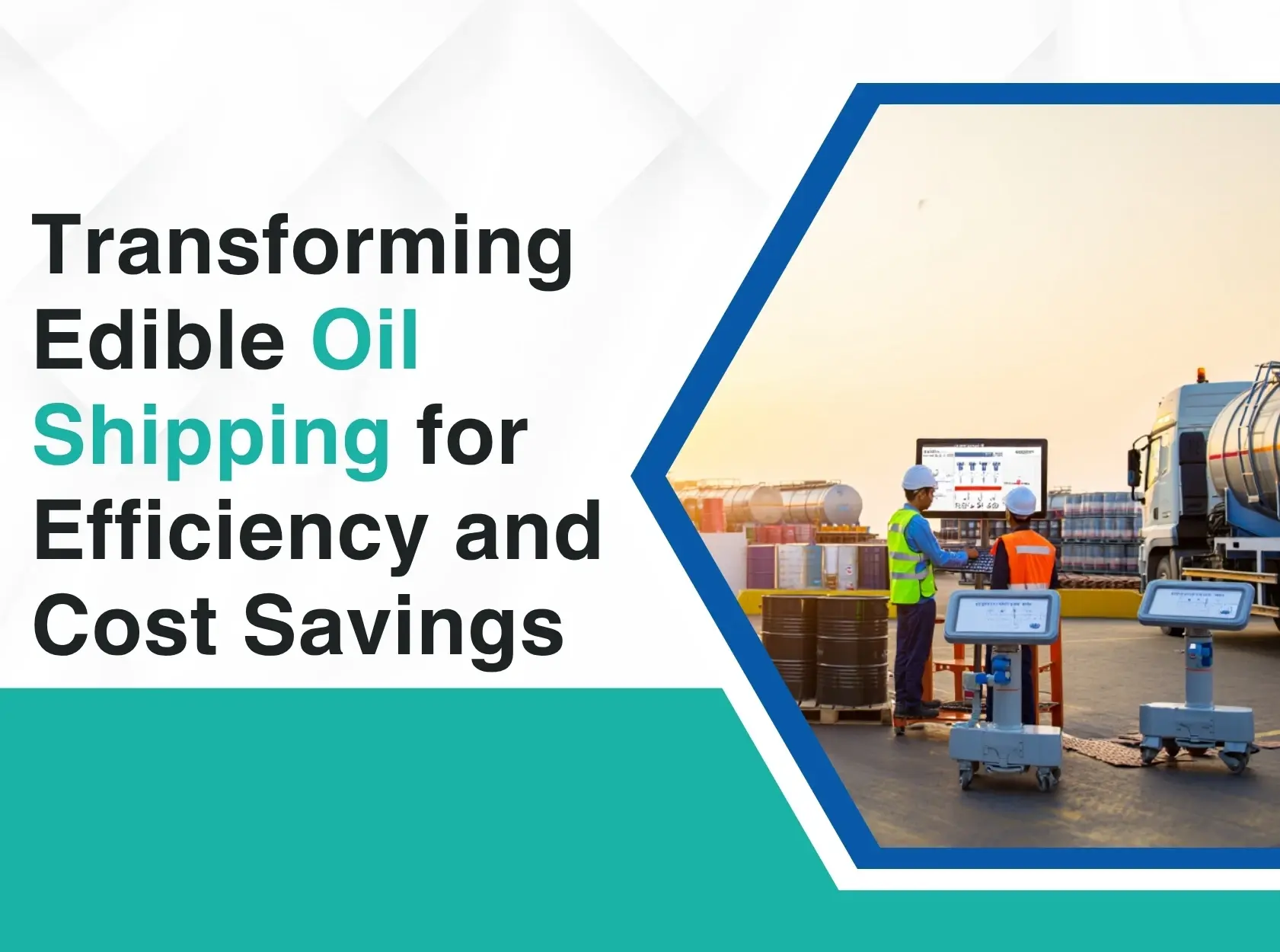
Transforming Edible Oil Shipping for Efficiency and Cost Savings

In India, edible oil is one of the most essential staple products, manufactured largely by big companies and distributed across the country through legacy supply chain networks, modern retail, and e-commerce platforms. While national brands enjoy widespread recognition, strong regional brand dominance exists across various parts of India.

Why focus on edible oil transportation? The key to market dominance isn’t just superior product quality but also seamless availability. In today’s competitive landscape, ensuring fulfillment at every touchpoint of the distribution network is critical, and digitization plays a pivotal role in achieving this.

Key Aspects of Edible Oil Transportation & Logistics in India

  • Heavy dependence on logistics service providers (LSPs) small and big.
  • A highly fragmented and unorganized sector
  • Fluctuating demand influenced by seasonality
  • High transportation costs per ton

Since edible oil falls under the category of fast-moving consumer goods (FMCG), SKU (Stock Keeping Unit) management plays a vital role in ensuring effective product placement and supply chain efficiency. Transportation costs significantly impact cost rationalization, making logistics optimization an essential requirement.

How Do We Optimize Transportation Costs & Improve Fulfillment?

The Answer: A Unified Logistics Platform
The solution is both simple and complex. The simple part? Using data and workforce efficiently. The complex part? Driving adoption and change management.

A Unified Logistics Platform  acts as the central nervous system of logistics operations, integrating multiple modules that simplify and automate logistics workflows.

This platform is tightly linked to a company’s ERP system, extracting data, applying intelligent logic, and enabling the operations team to execute tasks more efficiently.

Key Functions of a Unified Logistics Platform:

The Challenge: CHANGE Management

While the advantages of digitization are clear, the real challenge lies in adaptation. Transforming traditional logistics processes requires a cultural shift, training, and the right support system to ensure smooth adoption.

This is where companies like Spinclabs step in. We not only provide technical solutions but also guide businesses through the transformation journey with a structured approach to change management.

Our customer success team ensures stakeholders across the hierarchy feel comfortable with new systems, bridging the gap between technology and human adaptation.

How Does This Drive Brand Success?

Implementing a Unified Logistics Platform isn’t just about operational efficiency—it’s about market leadership. By streamlining logistics, reducing costs, and improving fulfillment rates, companies can enhance availability, build a stronger brand presence, and meet growing consumer demands with agility.

The brands that adapt to digitization today will define the future of edible oil distribution in India.

The question isn’t whether you should digitize—it’s how fast you can adapt. Are you ready to take the leap?
AI Transportation Management System for Fleet & Logistics

The digitization process has been rapidly accelerating, particularly in recent years with the mass introduction of AI across the board. This paradigm shift has acted as a catalyst and more scope for adaptability is created as it changes how the world works and how society functions. Even though AI is still in its infancy, its impact is already impressive and greater things will be on the horizon.

The global supply chain can be shaken up by AI too and so are the supply chain operations and decisions. At the very center of the logistics management process is the so-called Transportation management system which can be referred to as TMS and it acts as a critical hub for storing and managing all relevant logistics data and information.

The Logistics departments will continue to utilize TMS which will translate into a massive amount of data reproduction over a period of time. AI, when utilized correctly can analyze this data and provide valuable insights that can allow leadership teams to strategize, optimize operational efficiency, and monitor the supply chain more effectively.

Now lets see, what are the practical applications of AI and how one can use it to benefit the logistics and transportation operations.

  1. Planning: TMS stores daily information of planning data, how you are daily deciding the vehicles to optimize their capacity and also the cost to reduce transportation cost over all. AI can automate these planning tasks by integrating with TMS to:
  • Pull order details automatically.
  • Prioritize deliveries based on urgency.
  • Identify optimal routes.
  • Match the best available vehicles for each task efficiently.

    This ensures smarter resource allocation, minimizes delays, and reduces operational costs.

2. Tracking the Driver Performance: Nowadays every vehicle is GPS equipped and they are generating a lot of GPS probes. What is that these probes can tell about the Driver’s behavior? AI can analyze this data to:

  • Identify driving patterns and detect deviations from speed limits.
  • Calculate average speeds and flag unsafe driving practices.
  • Analyze sensor data to detect rule violations, such as harsh braking or sharp turns.

    These insights help create driver performance benchmarks, enabling better monitoring, corrective measures, and training for safer driving practices.

    Also Read: How Video Telematics Enhances Fleet Performance with Real Time Insights

3. Predictive Analytics for Multiple Things
i) Identify the best Transporter: A lot of data which is being captured during logistics operations, like Vehicle arrival time for loading, detention time, departure time from source, arrival time at source. ETA to the destinations etc. All the data tells you about the performance of the respective service providers. AI can analyze this data to rank transporters based on key performance indicators (KPIs) such as:

  • On-time deliveries.
  • Accuracy in documentation.
  • Timely bill submissions
    This ranking helps logistics managers choose reliable transport partners, ensuring efficiency and accountability.

ii) Controlling Damage: In consumer goods companies especially, the logistics companies face a lot of issues of damage and shortages in transit. How do you control it if data is not proper? In TMS there is historical data and with this historical data stored in TMS, AI can:

  • Instantly generate reports on damage costs for specific trips or transporters.
  • Highlight patterns or recurring issues with certain routes or service providers.
  • Provide actionable insights for negotiations and preventive measures.

    This data-driven approach empowers businesses to hold transporters accountable, reduce damage-related costs, and improve overall logistics performance.

By leveraging AI across these critical areas, logistics and transportation operations can achieve higher efficiency, cost savings, and better decision-making capabilities.