Your GPS Knows Where the Truck Is. Does Your Team Know What to Do Next?
Oct 21, 2026 · Transport Management
Visibility isn’t a screen. It’s an ecosystem- The data exists. It isn't connected.
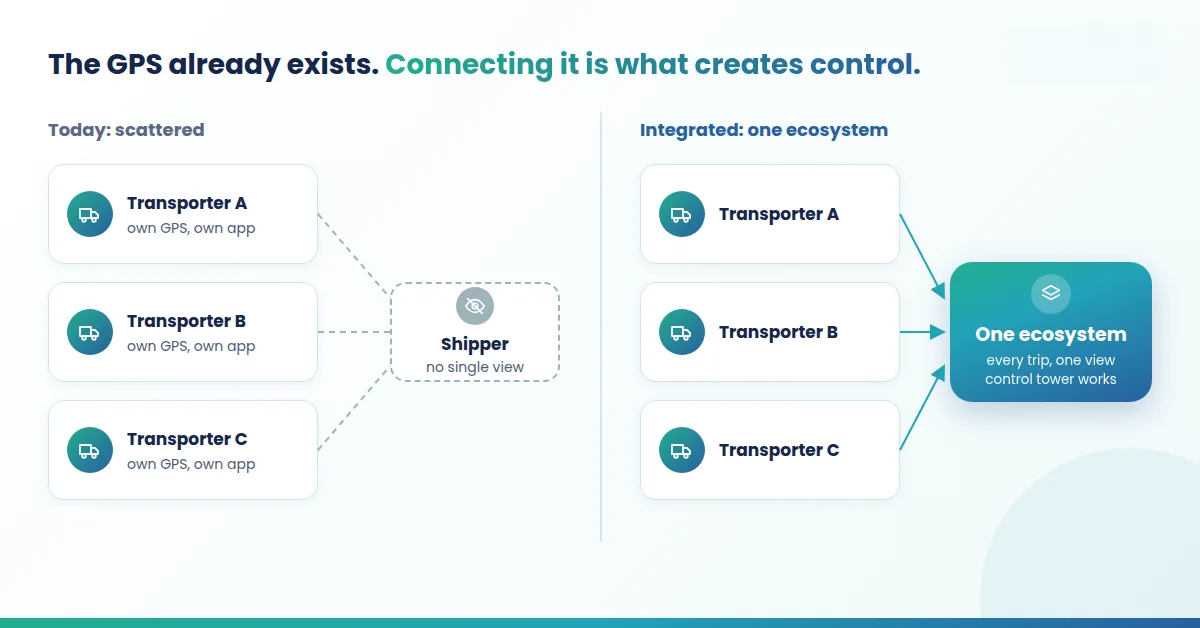
Indian shippers don’t lack GPS. Their transporters have it. What they lack is one view across every transporter, vendor, and app. Tracking that lives in someone else’s system isn’t visibility. Visibility is knowing which trips will miss their window, why, and who owns the fix. That comes from connecting the data, not collecting more of it.”
Tracking vs. visibility: the same moment, two outcomes
It’s 4:15 pm. A truck is 84 km from its destination. The GPS is live, the dot is moving, and the dashboard looks fine.
The delivery window closes at 5 pm.
The customer hasn’t been told. The receiving team is still expecting the truck. The operations manager can see exactly where the vehicle is, but not what to do about it.
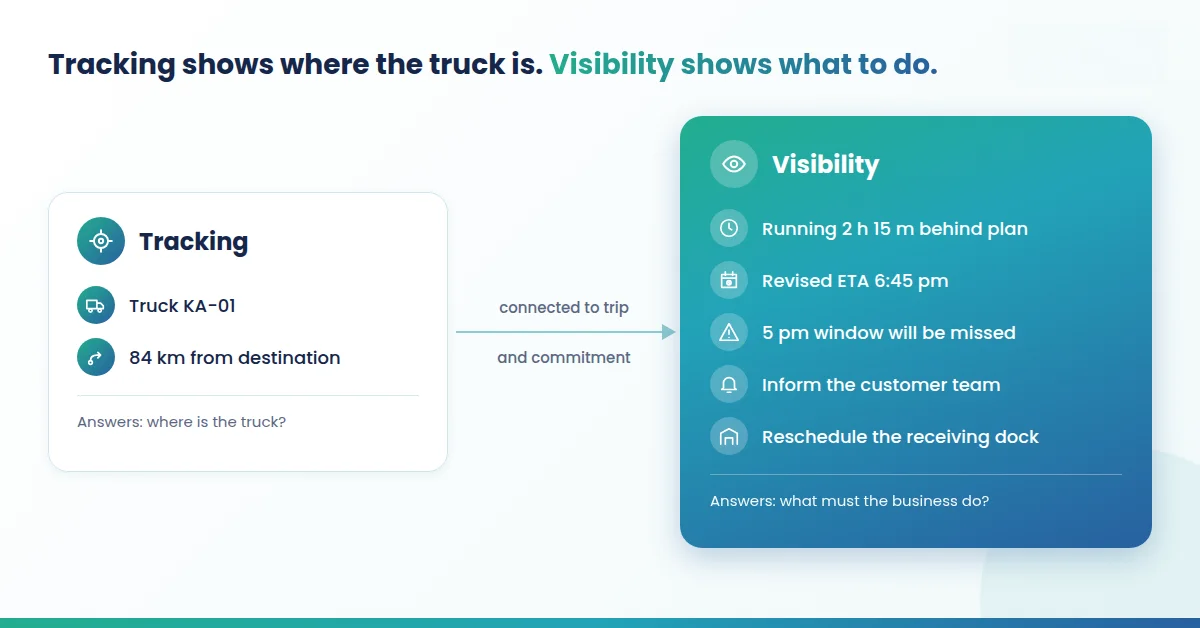
Tracking says: Truck KA-01, 84 km from destination.
Visibility says: Truck KA-01 is running 2 h 15 m behind plan. Revised ETA is 6:45 pm. The 5 pm window will be missed. The customer team needs to be informed, and the receiving dock needs to reschedule.
Tracking tells you where the truck is. Visibility tells you what the business has to do. The difference between the two isn’t more data. It’s connected data: the vehicle’s location, the trip it’s on, the transporter running it, and the delivery promised against it, all in one place.
Why control towers go dark at peak
Control towers rarely fail because data is missing. They fail because the data sits in too many places to come together in time.
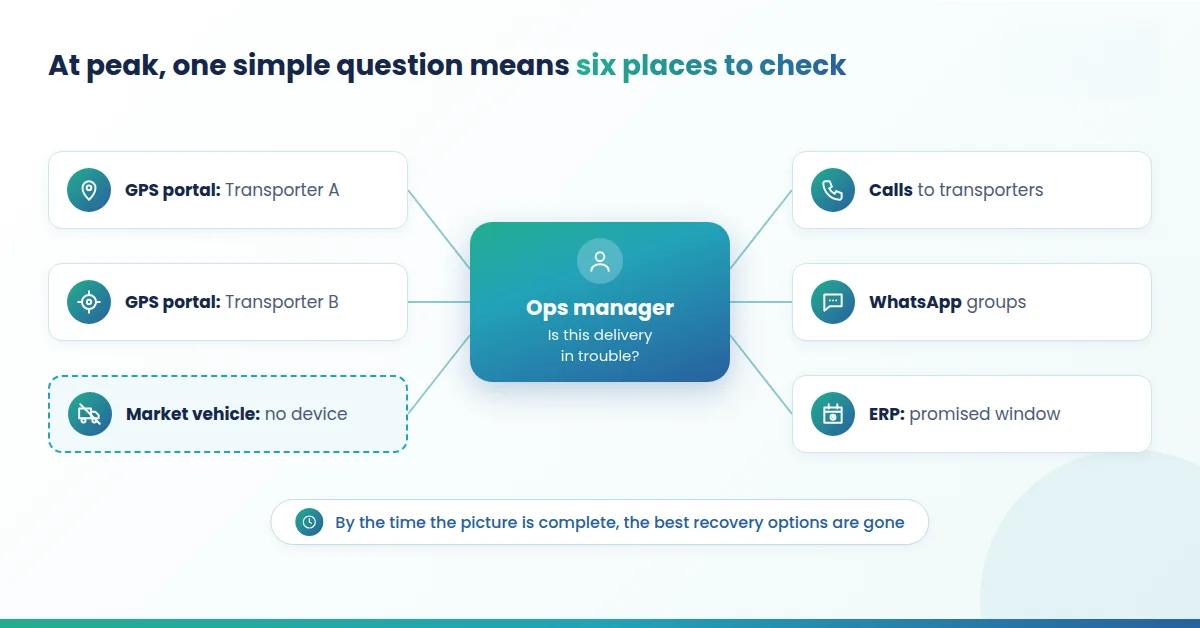
Take an operation running a few hundred trips a day. Some vehicles are your own. Most belong to contracted transporters, each with its own GPS vendor. At peak you add market vehicles, many with no device at all. On top of that, transporter communication runs across email, phone calls and WhatsApp groups.
Then peak season arrives. Volumes climb, loading runs late, and receiving yards fill up.
To answer one simple question, “is this delivery in trouble?”, someone has to log into three GPS portals, call a transporter to ask why a truck has stopped, check the ERP for the promised window, and message the customer team with a new ETA. By the time the picture is complete, the best options to recover the delivery are gone.
This isn’t a technology shortage. It’s an integration gap.
Integration comes first
You don't need to replace your transporters' GPS devices. You need everything you already have to work in one system-sources, integration layer, control tower
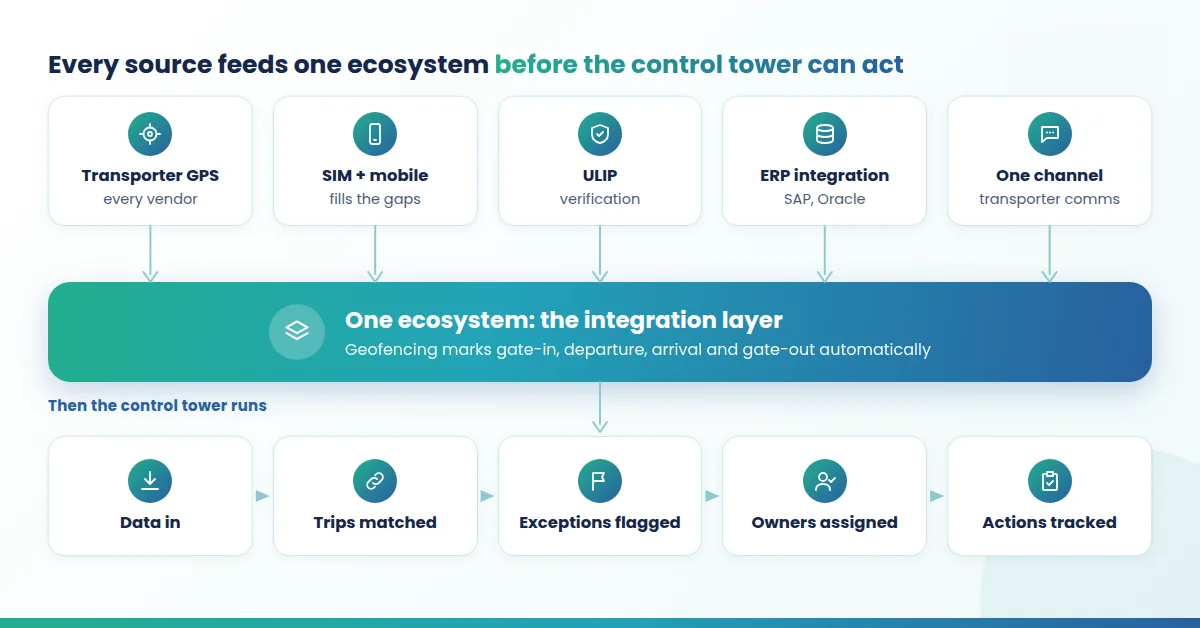
Consolidate every transporter's GPS feed. Pull feeds from different GPS vendors into one view, so no one has to switch platforms to understand a trip.
Fill the gaps with SIM and mobile tracking. Market vehicles and transporters without compatible GPS can be tracked through the driver's SIM or a mobile app. Accuracy varies by source, and a good control tower shows that openly.
Verify drivers and vehicles through ULIP. India's Unified Logistics Interface Platform, used through authorised integrations, supports driver and vehicle verification before a trip starts. It is a verification layer, not a live tracking source.
Integrate with your ERP. This is the step most control towers skip, and it matters most. A direct API integration with SAP, Oracle or your existing ERP ties every location ping to an order, a trip, a transporter and a promised delivery time. An ETA only means something when it's measured against a commitment.
Move transporter communication onto one channel. Schedules, confirmations, delays and ePODs flow through the same platform, not scattered across email, calls and WhatsApp.
Let geofencing mark the milestones. Gate-in, departure, arrival and gate-out are recorded automatically when a vehicle crosses a defined boundary.
This isn't an AI problem. It's an integration problem.
What a control tower should actually alert on?
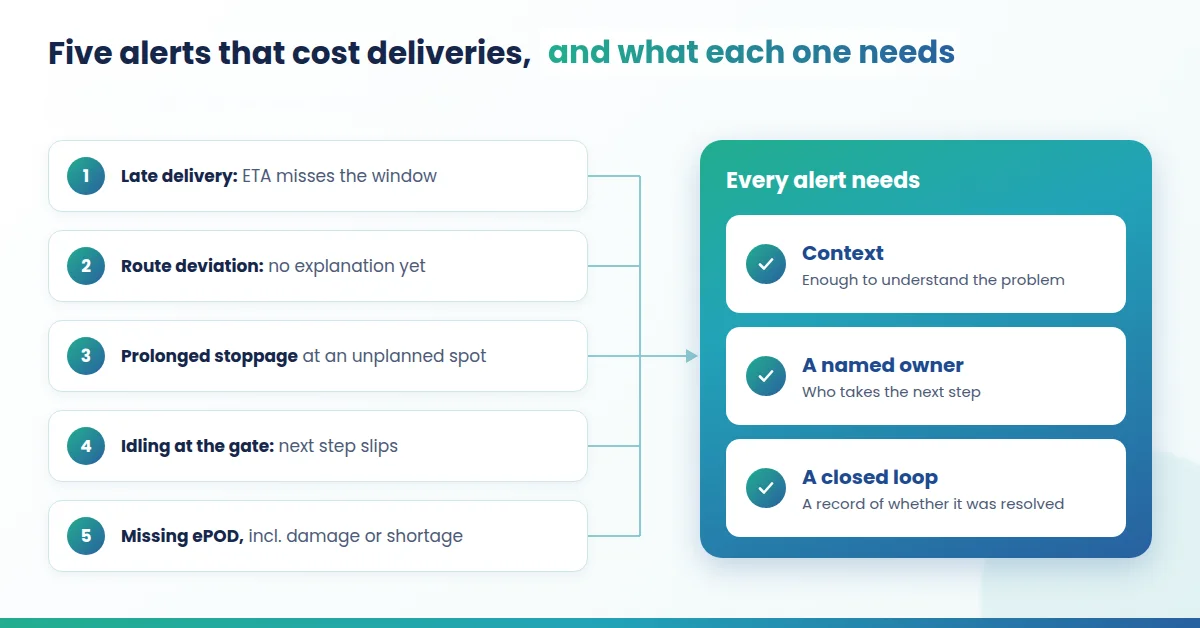
Five exceptions cost you deliveries:
A delivery running late. The revised ETA no longer fits the promised window.
An unexplained route deviation. The vehicle has left its planned route and someone needs to verify why.
A prolonged stoppage. The truck has been stationary at an unplanned location for longer than expected.
A vehicle idling at the gate. It has arrived, but the wait is pushing back the next milestone.
A missing or incomplete ePOD. The delivery looks complete, but the proof of delivery, including any damage or shortage, hasn’t been captured.
An alert on its own is only noise. Each one needs enough context to understand the problem, a named owner for the next step, and a record of whether it was resolved.
How to know your visibility is working?
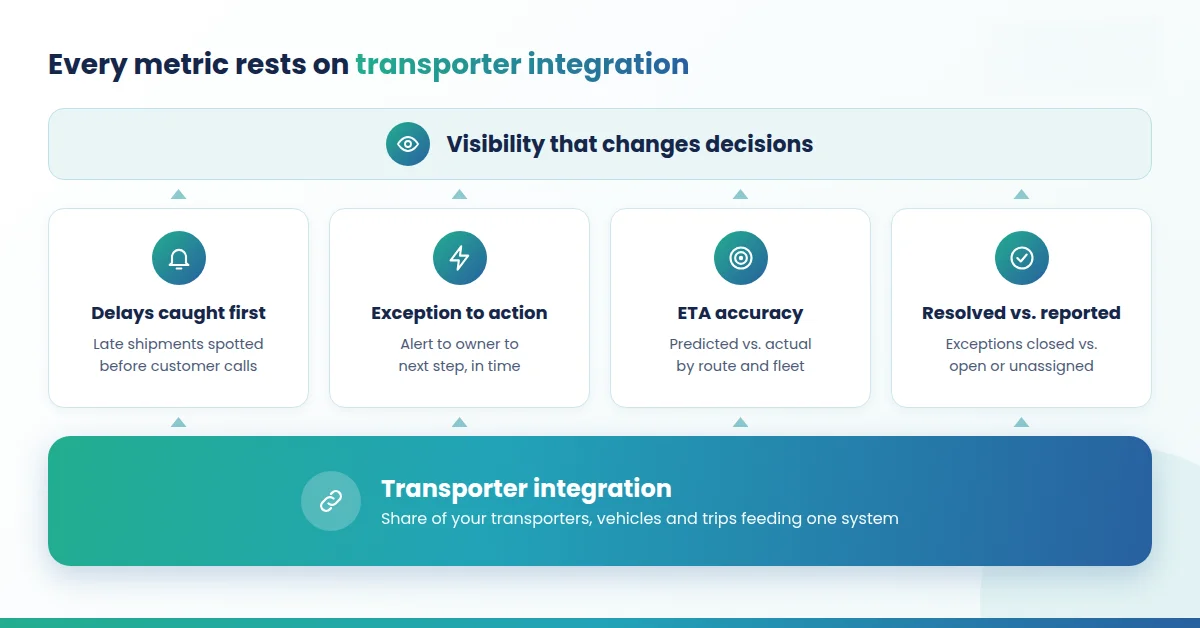
Measure what happens after the data arrives, not how many dots are on the map:
Transporter integration. What share of your transporters, vehicles and trips actually feed into the system? Everything else follows from this number.
Delays caught before the customer calls. What share of late shipments did you spot first?
Time from exception to action. How long between an alert, an owner acknowledging it, and the next step being logged?
ETA accuracy. Compare predicted and actual arrivals by route and fleet type.
Resolved vs. reported. How many exceptions get closed, and how many sit open or unassigned?
Set a baseline before you change anything, then review the same numbers every month.
Let’s find the gaps in your ecosystem
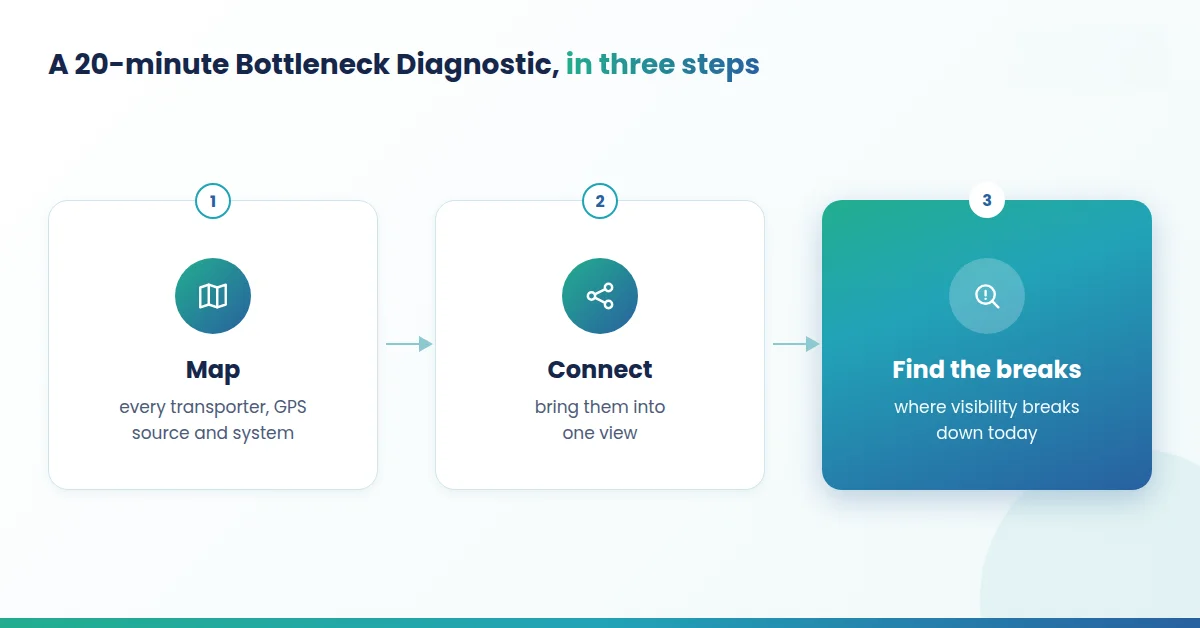
Book a 20-minute Bottleneck Diagnostic with Spinclabs. We’ll map every transporter, GPS source and system you already use, and show you exactly where your visibility breaks down today.